
Why the average American owns 4–6 water bottles (and what that means for brands)
Sep 14, 2026
Leave a message
In the Reddit thread "Which water bottle have you used the longest?" - the same thread where Nalgene earned the highest loyalty rating - one comment captured a pattern that runs through the entire discussion:
"I bring three water bottles with me to work, so just having one does me no good."
Multiple users echoed the same sentiment: one for home, one for the office, one for the car, one for outdoor activities. One bottle doesn't cover everything.

This isn't just a Reddit observation - it's backed by data. According to multiple studies, the average American owns 4 to 7 reusable water bottles. One report from 2026 specifically noted: "The average American owns 7.24 reusable water bottles". For context, the average person rotates bottles between the gym, the commute, and the office.
As a drinkware manufacturer, this tells us something important: the "one bottle fits all" approach no longer works. Consumers are building collections - and brands that understand this shift have a significant advantage.
The Numbers: How Many Bottles Do People Actually Own?
Let's start with the data. Multiple sources confirm that water bottle ownership in the U.S. is well above "one per person":
• A 2026 report found that the average American owns 7.24 reusable water bottles.
• Established studies indicate the average American owns 4 reusable water bottles - a rotation for the gym, the commute, and the office.
• 57% of Americans regularly carry a reusable water bottle, with the number jumping to 72% among 18-to-34-year-olds.
The global water bottle market was valued at USD 9.31 billion in 2025 and is expected to grow to USD 18.4 billion by 2035, at a CAGR of 5.2%. In the U.S. alone, the insulated bottle market is projected to reach $1.6 billion in 2026.
These numbers tell a clear story: people aren't buying one bottle and stopping. They're buying multiple, for multiple reasons, across multiple contexts.

The "Why": What Drives Multi-Bottle Ownership?
Why do people own so many water bottles? The Reddit thread and broader market data point to several key drivers:
Driver 1: Different scenarios demand different features.
As one industry report notes, "Scenario-based demand has become an important basis for water bottle selection". Different use scenarios correspond to specific capacity choices:
| Scenario | Typical Capacity | Key Requirements |
| Office | 400–500ml | Fits desk space, suitable for coffee/tea |
| Commuting | 500–750ml | Portable, not too bulky |
| Outdoor/Hiking | 1L+ | Large capacity,Continuous hydration |
| Gym | 600–900ml | Lightweight,Drink with one hand, leak-proof |
| Car | Any | Cup holder compatible, spill-proof |
The industry is moving from "one size fits all" to "multi-category coverage of细分场景," forming a product matrix with core categories at the base and scenario-specific categories as extensions
Driver 2: Water bottles as lifestyle accessories.
or younger consumers especially, water bottles have transcended their functional role. They've become fashion statements, self-care signals, and collectibles. As one article put it: "Hydration as self-care, and for Gen Z, it doubles as a statement: I care about myself". Young people keep multiple bottles so they never need to rely on single-use plastics.
The collector phenomenon is real. One analysis of Stanley owners found that 1 in 20 active collectors owns 90 or more bottles. The average "Super Collector" holds 158 bottles worth $6,155. While these are extreme cases, they show how far the "multiple bottles" trend can go.
Driver 3: Sustainability without compromise.
Owning multiple reusable bottles allows consumers to avoid single-use plastics in every situation - at work, in the car, at the gym, on the trail. Instead of buying a disposable bottle when they forget their main one, they have backups ready for different contexts. As one observer noted, "Youngsters seem to care about sustainability as well, suggesting why they own many bottles rather than buying plastic ones when out and about".
What This Means for Drinkware Brands
The multi-bottle trend isn't just a consumer curiosity - it's a fundamental shift in how the market works. Here's what it means for brands:
Implication 1: "One hero SKU" is no longer enough.
Stanley's Quencher was a phenomenon - a single SKU that drove massive growth. But even Stanley is now "building up hydration options for athletes, parents and others". The brands that succeed long-term will be those that build scenario-based product lines, not just single bestsellers.
Implication 2: Product lines should mirror real life.
A consumer's day might look like this:
• Morning coffee at home → ceramic or insulated mug
• Commute to work → cup-holder-friendly travel tumbler
• Desk hydration → narrow-mouth bottle that won't spill on documents
• Gym after work → lightweight,Drink with one hand sport bottle
• Weekend hike → large-capacity, durable outdoor bottle
A brand that offers solutions for each of these moments captures more of the consumer's "bottle rotation" - and more revenue.
Implication 3: Accessories and ecosystem matter.
If consumers own multiple bottles, they also need lids, straws, cleaning brushes, and carrying accessories. Brands that sell compatible accessories alongside their bottles create recurring revenue and deeper customer relationships. As one industry observer noted, Stanley's success came from "not just leaning into the Quencher and handy accessories like straws, but building up hydration options for athletes, parents and others".
Implication 4: Limited editions and colorways drive collection behavior.
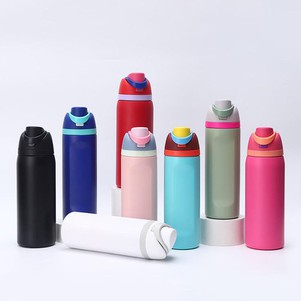
The collector phenomenon shows that consumers will buy the same bottle model in multiple colors. Limited colorway drops create urgency and repeat purchases. Owala's 2024 strategy "borrowed Stanley's drop mechanics directly" - limited releases that drive FOMO and collection. For manufacturers, this means color and finish options are as important as functional features.

The Manufacturer's Opportunity
For a drinkware manufacturer, the multi-bottle trend represents a clear strategic opportunity:
Opportunity 1: Build a scenario-based product matrix.
Instead of offering one or two generic bottles, design products for specific scenarios: office, commute, gym, outdoor, travel. Each should have distinct features that match the use case. As one industry report notes, "Scenario-based has become the main of cup and bottle product innovation". Office, outdoor sports, home life, business commuting, and child care are all specialized product needs-.
Opportunity 2: Differentiate by solving scenario-specific pain points.
The Reddit thread revealed specific complaints: bottles that don't fit cup holders, bottles that are hard to clean, bottles that don't keep ice long enough【see findings from earlier analyses】. Each of these is a scenario-specific problem waiting for a solution.
Opportunity 3: Think beyond the bottle.
If consumers own 4–7 bottles, they also need storage, cleaning, and accessories. Can you offer a bottle ecosystem - compatible lids, straws, cleaning kits, carrying bags - that makes owning multiple bottles more convenient?
Opportunity 4: Leverage color and finish as a differentiator.
The collector trend shows that consumers will buy the same functional bottle in multiple colors. Offering a rotating palette of limited-edition colors can drive repeat purchases from the same customer - without requiring new tooling or major R&D investment.
The Reddit user who brings three water bottles to work isn't unusual. They're the new normal. The average American owns 4 to 7 reusable water bottles, and that number is likely to grow as hydration becomes more embedded in daily life and water bottles continue their transformation from utility item to lifestyle accessory.
For drinkware brands, this means one thing: stop trying to build one bottle for everyone. Start building a lineup for every moment of the day.
At [Polywell Group], we understand that modern consumers don't want one bottle - they want the right bottle for every part of their life. That's why we design with scenarios in mind, not just specifications.
Send Inquiry