
The #1 complaint about water bottles that nobody is fixing: cup holder compatibility
Aug 27, 2026
Leave a message
Scroll through any water bottle review section on Amazon, Reddit, or YouTube, and you'll find one complaint that keeps coming up: "It doesn't fit in my car's cup holder." This isn't a niche issue - it's the single most mentioned physical usability problem across almost every major brand. And surprisingly, almost no one is fixing it.
In the Reddit thread "Which water bottle have you used the longest?" - the same thread where Nalgene earned the highest loyalty rating - one user simply said: "They don't fit in cup-holders," and it received 98 upvotes-. Another added: "I just got sick of my Nalgene blowing out the side pouches of my backpacks, rolling around my car." Two short sentences, hundreds of people nodding along.

As a Chinese drinkware manufacturer, this is exactly the kind of "small problem" that represents a big opportunity. Let's look at the numbers.
The Numbers: Why Most Popular Bottles Don't Fit
Let's start with the standard car cup holder. According to industry data, most factory-installed cup holders in North American and European vehicles manufactured since 2010 have an internal diameter between 2.5 and 3.5 inches. The most common size is around 3 inches. Some vehicles go up to 3.5 inches, but many are narrower - especially in sedans and compact cars.
Now, here are the diameters of some of the most popular water bottles on the market today:
| Brand & Model | Diamete |
| Nalgene 32oz Wide Mouth | 3.5 inches (89mm) |
| Hydro Flask 32oz Wide Mouth | 3.56 inches (90.5mm) |
| YETI Rambler 26oz | 3.4 – 3.5 inches |
| Owala FreeSip 24oz | 2.9 inches (74mm) |
| Stanley Quencher 30oz | 3.15 inches (base) |
| Stanley Quencher 40oz | 3.1 inches (base)- |

Notice the pattern? Nalgene, Hydro Flask, and YETI - three of the most trusted brands in the market - all sit right at or above the 3.5-inch mark. That means they barely fit into the largest cup holders and simply won't fit into the more common 3-inch ones. Owala and Stanley have done better by tapering their bases, but even they are pushing the limits of what most cup holders can accommodate.
The Gap: What "Standard" Actually Means
Here's the irony: the 3.5-inch diameter that Nalgene and Hydro Flask use isn't arbitrary - it's driven by bottle capacity. A 32oz bottle needs a certain base width to stand stable. But car cup holders aren't designed for 32oz bottles. They're designed for a 12oz soda can (about 2.6 inches in diameter) or a standard coffee cup (about 3 inches).
So we have a fundamental mismatch: bottle designers optimize for capacity and stability; car designers optimize for cans and coffee cups. The user is caught in the middle, with a bottle that rolls around the passenger seat or tips over at the first turn.
Some brands have started to notice. Stanley explicitly markets the Quencher as "car cup holder compatible" with a 3.15-inch base. Owala's 2.9-inch diameter is one of the most cup-holder-friendly on the market. But these are exceptions, not the rule. The vast majority of insulated stainless steel bottles in the 32oz and above range still hover around 3.5 inches - and that's a problem.
Why Nobody Is Fixing It (Yet)
The answer is surprisingly simple: fixing cup holder compatibility means reducing base diameter, which reduces capacity or compromises stability. A 32oz bottle with a 2.9-inch base would be tall and tippy. A 40oz bottle with a 3.1-inch base is already pushing it - Stanley had to add a wide handle just to make it carryable.
So the trade-off is real. But that doesn't mean there's no solution. Some brands have started using tapered designs - a wider body that narrows at the base. Others are experimenting with detachable cup holder adapters. But these are workarounds, not fundamental design improvements.
For a manufacturer, this represents a clear white space. A bottle that offers 32oz capacity with a base diameter under 3.2 inches - without compromising stability - would solve the #1 complaint in the category. That's not just a feature; that's a competitive moat.
What This Means for Your Brand
If you're sourcing or manufacturing drinkware for the North American market, cup holder compatibility isn't a nice-to-have - it's becoming a must-have. Here's why:
First, the complaint is ubiquitous. From Reddit to Amazon reviews to YouTube comments, "doesn't fit in cup holder" is one of the most consistent negative feedback points across virtually every major brand. Solving it differentiates you immediately.
Second, the market is moving. Stanley has already made cup holder compatibility a key selling point. Owala's narrower base is part of why it's gaining market share so quickly. The early movers are already capturing the "car commuter" segment.
Third, it's a tangible, measurable differentiator. Unlike "premium quality" or "great design" - which are subjective - cup holder fit is binary: it fits or it doesn't. That makes it easy to communicate and easy for customers to verify.
The Manufacturer's Opportunity
For Chinese drinkware manufacturers, this is a classic white-space opportunity. The major Western brands are locked into their existing tooling and diameters. Retooling a production line for a narrower base is expensive and risky. That means they're slow to move.
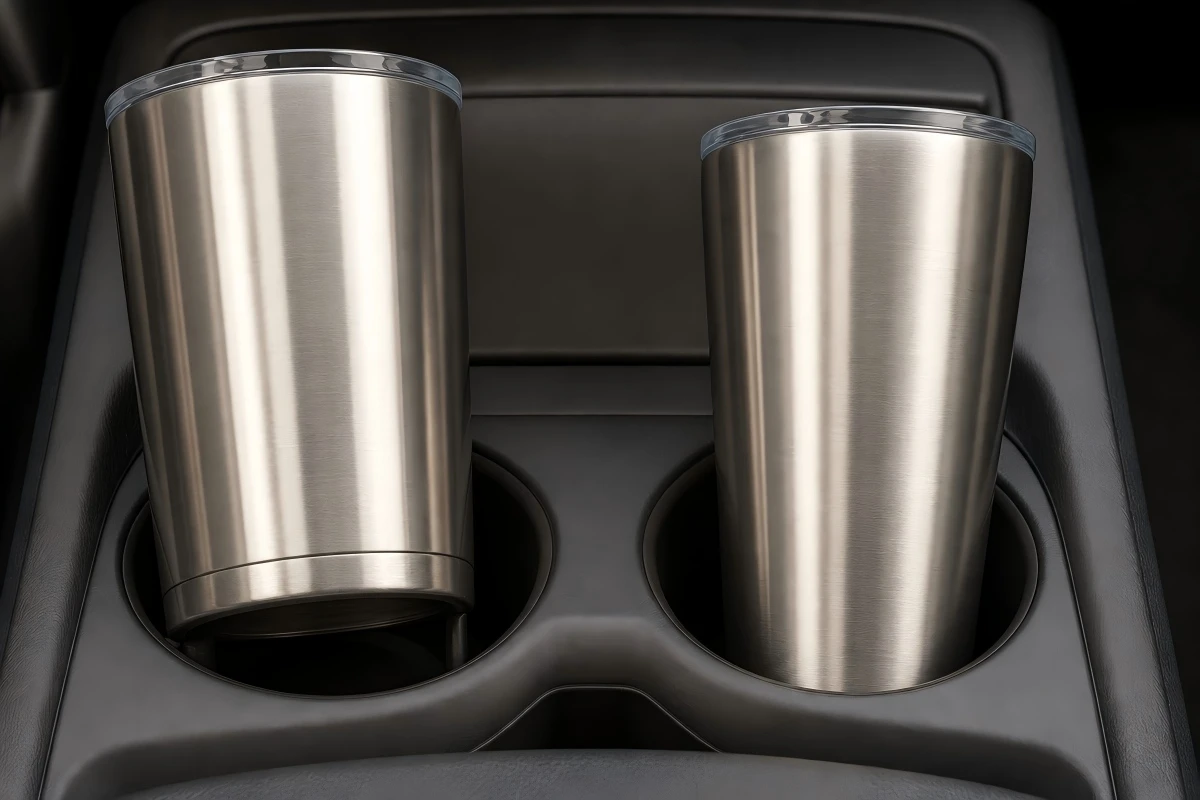
But if you can offer a bottle that:
Holds 28–32oz
Has a base diameter of 3.0–3.2 inches
Maintains stability (wide enough base, low center of gravity)
Keeps ice for 24 hours (the standard Hydro Flask promise)
…you've just solved the #1 complaint in the category. And you've done it while the big brands are still figuring out how to respond.
This isn't about copying Nalgene or Hydro Flask. It's about listening to what users are actually saying - and building a product that answers their real-world problems. That's how you go from OEM to OBM.
Send Inquiry